NoteArch: Transforming Academic Management for Modern Educational Institutions
NoteArch Transforming Academic Management
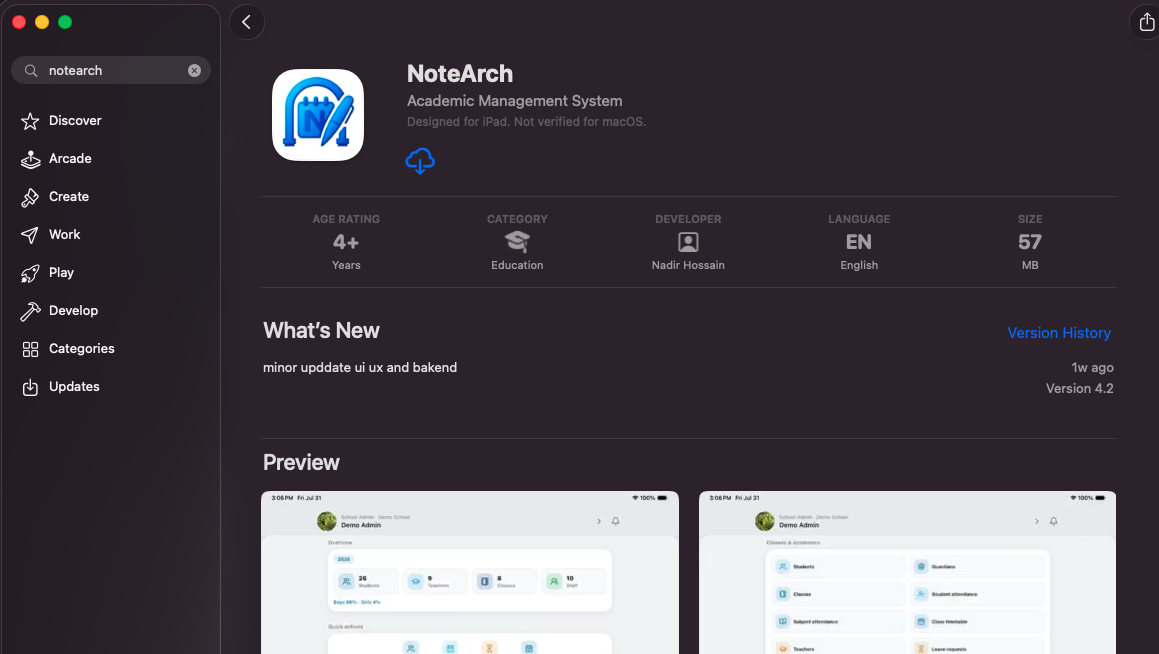
NoteArch Is Now Available on the Apple App Store: A New Era of Intelligent Academic Management
The education sector is undergoing a profound digital transformation. Schools, colleges, universities, and other educational institutions around the world are increasingly moving beyond traditional administrative systems to embrace technology that can make academic operations more connected, efficient, secure, and accessible.
Today marks an important milestone in that journey: NoteArch, our comprehensive Intelligent Academic Lifecycle Management System, is now available on the Apple App Store.
This launch represents more than the release of a mobile application. It is another step toward our broader vision of creating a unified digital ecosystem that connects institutions, teachers, students, parents, tutors, and other stakeholders throughout the complete academic lifecycle.
The Problem We Set Out to Solve
Educational institutions manage an enormous amount of information and daily activity.
Student attendance, class schedules, assignments, examinations, academic records, teacher communication, parent communication, administrative operations, and reporting all require continuous coordination. When these processes depend on paper records, spreadsheets, manual workflows, or multiple disconnected systems, institutions can face unnecessary complexity, duplicated work, data inconsistencies, and delays.
More importantly, administrative responsibilities can take valuable time away from educators and academic teams.
We designed NoteArch after examining these challenges and listening to the needs of administrators, teachers, students, and parents.
The message was consistent: educational institutions needed a unified, easy-to-use, secure, and purpose-built platform that could bring academic and administrative activities together without requiring users to become technology experts.
That is the problem NoteArch was built to address.
What Makes NoteArch Different
NoteArch is not designed as simply another school management application.
It is designed as an interconnected academic ecosystem where different stakeholders can access the information, tools, and communication channels relevant to their roles.
Comprehensive Academic Management
NoteArch brings a broad range of academic activities into one connected environment.
Teachers can manage classes, publish lessons and assignments, record attendance, communicate with students and parents, and manage their academic responsibilities.
Students can access schedules, academic resources, assignments, examination information, results, and virtual learning activities.
Parents can stay informed about their child's academic progress, attendance, announcements, and other relevant activities.
Administrators can manage institutional operations through centralized dashboards, oversee users and academic activities, generate reports, and access information needed for better decision-making.
The objective is to reduce fragmentation and create a consistent digital experience across the institution.
Enterprise-Grade Security and Privacy
Educational information is highly sensitive. Student records, academic results, attendance information, staff information, and institutional data must be handled responsibly.
Security and privacy were therefore fundamental considerations in the architecture of NoteArch.
Each subscribing institution operates within its own isolated database environment, helping ensure that institutional information remains separated from other institutions.
Role-based access controls are also used to ensure that users can access only the information and functionality appropriate to their responsibilities.
For sensitive activities such as staff attendance verification, NoteArch can incorporate biometric authentication and controlled location verification to strengthen accountability and reduce opportunities for fraudulent attendance records.
Our approach is straightforward: security and privacy should be built into the system, not added as an afterthought.
Designed for Real-World Users
Technology is only useful when people can actually use it.
Educational institutions include people with very different levels of technical experience. Teachers may not have time to learn complicated software. Parents may only have a few minutes to check their child's progress. Students expect modern and familiar digital experiences.
NoteArch was therefore designed around simplicity and usability.
The interface is intended to be intuitive, structured, and easy to navigate. Users should be able to perform everyday academic tasks without having to understand complicated technical processes.
This allows institutions to introduce digital academic management without creating an additional technology burden for their users.
Scalable and Flexible
Educational institutions vary significantly in size, structure, and operational requirements.
A small school may have several hundred students, while a large institution may manage thousands of students, teachers, staff members, and academic records.
NoteArch is designed to accommodate institutions across different scales.
Its modular architecture allows institutions to use the functionality relevant to their requirements while supporting workflows that can adapt as their operational needs evolve.
As an institution grows, its academic management system should grow with it rather than forcing the institution to replace its entire technology infrastructure.
The Journey to the Apple App Store
Bringing NoteArch to the Apple App Store was an important part of our journey.
The App Store review process places significant emphasis on application quality, privacy, functionality, business-model transparency, and responsible use of device permissions.
During the review process, we addressed several areas to ensure that NoteArch met the required standards.
One of the challenges was demonstrating the complete functionality of an enterprise academic system without exposing real customer information.
Because every NoteArch institution operates within its own private academic environment, providing reviewers with access to real institutional data was not appropriate.
Instead, we created a dedicated demonstration environment containing realistic but fictional academic data. This allowed the review team to experience the application's functionality while maintaining the privacy and security of real institutional users.
We also reviewed our location-permission architecture.
Rather than requiring continuous background location access, we refined the implementation so that location information is used when it is actually required for activities such as staff attendance check-in and check-out.
This approach provides the necessary functionality while reducing unnecessary access to sensitive device information.
How NoteArch Works
The NoteArch model is designed around educational institutions.
Institutions subscribe to NoteArch through the platform's official channels. Once an institution is onboarded, administrators can create and manage accounts for teachers, staff, students, parents, and other authorized users.
Users can then access the appropriate NoteArch environment through supported mobile and web interfaces using their institutional credentials.
The institution manages the system centrally, including user access and institutional operations.
There are no individual in-app purchases required for students, teachers, or parents. The institution's subscription model is designed to provide access to its authorized users without requiring every individual stakeholder to purchase a separate subscription.
This creates a simpler and more predictable model for educational institutions.
The Impact We Aim to Create
The success of educational technology should ultimately be measured by how effectively it improves the academic environment.
By reducing repetitive administrative work, NoteArch aims to give teachers and academic staff more time to focus on teaching and student support.
By providing parents with easier access to relevant academic information, the platform can help strengthen parental engagement.
By bringing schedules, assignments, academic information, communication, and other resources into one environment, students can have a more connected academic experience.
For administrators, centralized information and reporting can help improve operational visibility, data management, and decision-making.
Attendance management can become more structured and accountable, while communication between institutions, teachers, students, and parents can become faster and more transparent.
The ultimate goal is not simply to digitize existing processes, but to make those processes more meaningful and efficient.
Looking Ahead
The Apple App Store launch is an important milestone, but it is not the destination.
NoteArch is being developed as a continuously evolving academic technology ecosystem.
As we move forward, we are exploring capabilities such as advanced academic analytics, early identification of students who may require additional support, deeper integrations with learning management systems, and enhanced tools for virtual and hybrid learning.
We are also working toward broader language support and greater adaptability for different educational systems and regions.
Education is universal, but educational practices are not identical everywhere. Different countries, institutions, curricula, and communities have different requirements.
Our goal is to build NoteArch with enough flexibility to support these diverse environments while maintaining a consistent foundation of security, usability, intelligence, and academic connectivity.
Why This Matters
Education is one of the most important foundations of human development.
When we improve the tools used by educational institutions, the impact extends far beyond software.
Reducing administrative complexity can give educators more time to teach.
Improving communication can help parents become more engaged in their children's education.
Making academic information easier to access can help students remain connected to their learning journey.
Providing institutions with better information can support more effective planning and decision-making.
This is why we believe educational technology should not make education more complicated.
Technology should serve education.
It should be accessible, practical, secure, and designed around the people who use it.
That philosophy is at the heart of NoteArch.
Join the NoteArch Journey
If you are part of an educational institution looking to modernize academic and administrative management, we invite you to explore NoteArch and discover how an integrated Intelligent Academic Lifecycle Management System can support your institution.
NoteArch is now available on the Apple App Store.
Download NoteArch from the Apple App Store:
https://apps.apple.com/us/app/notearch/id6756450121
Learn more about NoteArch:
https://notearch.com/
We also welcome feedback from educators, administrators, students, parents, technology professionals, and anyone passionate about improving education through technology.
The strongest educational technology solutions are built by understanding real-world academic challenges and continuously learning from the people who experience them.
We are only at the beginning of this journey.
NoteArch - Digitalizing the Academic World, Powered by Artificial Intelligence.
Thank you for being part of our journey toward a more connected, intelligent, and accessible future for education.